Epoch-based garbage collection wrapper. More...
#include <stdbool.h>#include <stddef.h>#include <ttak/compat/stdatomic.h>#include <ttak/mem/epoch_gc.h>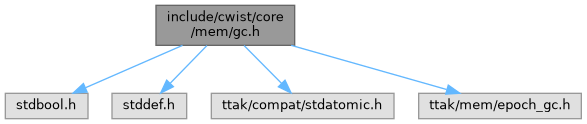

Go to the source code of this file.
Classes | |
| struct | cwist_gc |
| High-level wrapper over libttak's epoch GC. More... | |
Typedefs | |
| typedef struct cwist_gc | cwist_gc_t |
| High-level wrapper over libttak's epoch GC. | |
| typedef atomic_bool | cwist_release_guard_t |
| One-shot guard ensuring a shared teardown path runs exactly once. | |
| typedef void(* | cwist_conn_close_fn) (void *handle) |
| Full-GC's connection registry: thread/process-exit sweep for resources that aren't plain cwist_alloc() memory – sockets, TLS sessions, protocol-level state – so a worker thread (or the whole process) ending without an explicit destroy-family call still closes them, instead of leaving them for the peer/OS to notice. See docs/GC.md sections 2-3. There is no cwist_conn_t in this codebase (connection lifecycle is protocol-specific – http.c/http2.c/http3.c/ https.c/grpc.c/grpc_client.c each own their own), so this tracks (handle, close_fn) pairs instead of a concrete type. | |
Functions | |
| void | cwist_gc (cwist_gc_t *gc, bool manual_rotation) |
| Initialize (if needed) and configure the GC context. | |
| void | cwist_gc_shutdown (cwist_gc_t *gc) |
| Shut down and free internal GC state. | |
| void | cwist_gc_rotate (cwist_gc_t *gc) |
| Rotate the GC epoch and reclaim retired nodes. | |
| void | cwist_gc_auto_rotate (cwist_gc_t *gc, bool enabled) |
| Toggle whether the GC context reclaims automatically. | |
| bool | cwist_gc_auto_rotated (cwist_gc_t *gc) |
| Check whether the GC context is currently set to auto-rotate. | |
| void | cwist_reg_ptr (cwist_gc_t *gc, void *ptr) |
| Register a pointer without specifying a size (defaults to 0). | |
| void | cwist_reg_ptr_sized (cwist_gc_t *gc, void *ptr, size_t size) |
| Register a pointer and its size for better accounting. | |
| ttak_epoch_gc_t * | cwist_gc_raw (cwist_gc_t *gc) |
| Obtain the raw libttak epoch GC pointer (advanced usage). | |
| void * | cwist_ebr_alloc (size_t size) |
| Allocate a block meant to be released through cwist_ebr_free(). | |
| void | cwist_ebr_free (void *ptr) |
| Defer release of a block shared across threads via epoch reclamation. | |
| void | cwist_gc_pipeline_tick (void) |
| Drive the EBR pipeline: attempt to advance the epoch and run any cwist_ebr_free() callbacks that are now safe to execute. | |
| void | cwist_full_gc (bool enable) |
| Enable or disable full-GC mode process-wide. | |
| bool | cwist_full_gc_enabled (void) |
| Check whether full-GC mode is currently enabled. | |
| bool | cwist_full_gc_locked (void) |
| Check whether the full-GC toggle has been latched (i.e. cwist_full_gc() has been called once already and every further call will be ignored). Diagnostic/testing use. | |
| void * | cwist_full_gc_guard_page (void) |
| Raw pointer to the full-GC toggle's guard page, or NULL if the mmap() backing it failed at process startup. Advanced/testing use only – e.g. to confirm the page is actually read-only after cwist_full_gc() has been called once. | |
| void | cwist_gc_scope_track (void *ptr) |
| Register a cwist_alloc() block with the current thread's pending-sweep list (full-GC mode only). | |
| bool | cwist_gc_scope_untrack (void *ptr) |
| Remove a block from the current thread's pending-sweep list. | |
| bool | cwist_gc_scope_disown (void *ptr) |
Remove ptr from the current thread's pending-sweep list without freeing it, because ownership is being handed off to other code that will call cwist_free() (or cwist_ebr_free()) on it later, possibly from a different thread. | |
| void | cwist_gc_scope_flush (void) |
| Retire every block still on the current thread's pending-sweep list right now, instead of waiting for the thread to exit. | |
| size_t | cwist_gc_scope_pending_count (void) |
| Number of blocks currently on the calling thread's pending-sweep list. Introspection/testing helper. | |
| void | cwist_release_guard_init (cwist_release_guard_t *guard) |
| Initialize a release guard to its unclaimed state. | |
| bool | cwist_release_guard_acquire (cwist_release_guard_t *guard) |
| Attempt to claim the guard. | |
| void | cwist_conn_registry_track (void *handle, cwist_conn_close_fn close_fn) |
| Register a connection handle for the full-GC exit sweep, owned by the calling thread (full-GC mode only; a no-op otherwise, so callers can call this unconditionally at connection-open time). | |
| bool | cwist_conn_registry_adopt (void *handle) |
| Make the calling thread the owner of a tracked handle. | |
| bool | cwist_conn_registry_untrack (void *handle) |
| Remove a handle from the registry before closing it yourself through the normal explicit path. | |
| void | cwist_conn_registry_flush (void) |
| Close every handle the calling thread owns right now, without waiting for thread exit. Analogous to cwist_gc_scope_flush() but for connections. | |
| void | cwist_conn_registry_sweep_all (void) |
| Sweep every thread's pending-sweep list right now. This is what the process-exit (atexit) hook calls; exposed directly for testing, or for callers that want a deterministic sweep point earlier than actual process exit (e.g. cwist_app_destroy()). | |
| size_t | cwist_conn_registry_pending_count (void) |
| Number of tracked connections the calling thread owns. Introspection/testing helper. | |
Detailed Description
Epoch-based garbage collection wrapper.
Definition in file gc.h.
Typedef Documentation
◆ cwist_conn_close_fn
Full-GC's connection registry: thread/process-exit sweep for resources that aren't plain cwist_alloc() memory – sockets, TLS sessions, protocol-level state – so a worker thread (or the whole process) ending without an explicit destroy-family call still closes them, instead of leaving them for the peer/OS to notice. See docs/GC.md sections 2-3. There is no cwist_conn_t in this codebase (connection lifecycle is protocol-specific – http.c/http2.c/http3.c/ https.c/grpc.c/grpc_client.c each own their own), so this tracks (handle, close_fn) pairs instead of a concrete type.
◆ cwist_gc_t
High-level wrapper over libttak's epoch GC.
These helpers keep initialization/destruction scoped to CWIST so applications can toggle GC behavior without touching libttak internals.
◆ cwist_release_guard_t
One-shot guard ensuring a shared teardown path runs exactly once.
Use this when the same release path (e.g. detaching two sibling references and freeing what they both point to) may be entered concurrently from more than one thread, and exactly one of them must win. Initialize with cwist_release_guard_init(); every racer then calls cwist_release_guard_acquire() and only the caller that gets true back performs the detach + free.
Function Documentation
◆ cwist_conn_registry_adopt()
Make the calling thread the owner of a tracked handle.
Call this when a thread takes over serving a connection another thread tracked (pool resubmit, parked-connection resume, async completion that keeps the connection). Without it, the tracking thread's exit would close a connection the new thread is still using (#345).
- Returns
- true if
handleis tracked and now owned by the caller; false if it is not tracked or full GC is off.
- Parameters
-
handle Handle previously passed to cwist_conn_registry_track().
- Returns
- true when
handleis tracked (and now owned by the caller); false when it is not tracked or full GC is off.
Definition at line 1025 of file gc.c.
References cap, and cwist_full_gc_enabled().
◆ cwist_conn_registry_flush()
Close every handle the calling thread owns right now, without waiting for thread exit. Analogous to cwist_gc_scope_flush() but for connections.
Ownership follows cwist_conn_registry_adopt(), but a connection this thread tracked and another thread serves without adopting it (a parked or deferred connection) is still owned here, so call this only when none of them can still be in use. The cwist CLI warns on call sites not marked cwist-ack: cwist_conn_registry_flush.
Close every handle the calling thread owns right now, without waiting for thread exit. Analogous to cwist_gc_scope_flush() but for connections.
The registry stays usable afterwards; later tracks work as before.
◆ cwist_conn_registry_pending_count()
Number of tracked connections the calling thread owns. Introspection/testing helper.
After fork() the child starts with an empty registry: the inherited connections belong to the parent, and a child that exits must not shut them down.
Number of tracked connections the calling thread owns. Introspection/testing helper.
- Returns
- Number of owned entries; 0 when nothing is tracked.
Definition at line 1060 of file gc.c.
References cap.
◆ cwist_conn_registry_sweep_all()
Sweep every thread's pending-sweep list right now. This is what the process-exit (atexit) hook calls; exposed directly for testing, or for callers that want a deterministic sweep point earlier than actual process exit (e.g. cwist_app_destroy()).
Sweep every thread's pending-sweep list right now. This is what the process-exit (atexit) hook calls; exposed directly for testing, or for callers that want a deterministic sweep point earlier than actual process exit (e.g. cwist_app_destroy()).
Intended for process-exit paths. Each handle is removed before it is closed, so racing sweeps (atexit vs. a thread's own exit) close it once.
Definition at line 1052 of file gc.c.
References cap.
◆ cwist_conn_registry_track()
| void cwist_conn_registry_track | ( | void * | handle, |
| cwist_conn_close_fn | close_fn | ||
| ) |
Register a connection handle for the full-GC exit sweep, owned by the calling thread (full-GC mode only; a no-op otherwise, so callers can call this unconditionally at connection-open time).
The registry is one process-wide table. Each handle has an owner thread; that thread's exit sweep (or cwist_conn_registry_flush()) closes it. The owner is the tracking thread until cwist_conn_registry_adopt() moves it.
- Parameters
-
handle Opaque connection handle, passed back to close_fn.close_fn Called with handleto close/tear it down; must be safe to call from whichever thread ends up sweeping it (the owning thread at its own exit, or any thread running the atexit sweep at process exit). It is called with no registry lock held and may track or untrack other handles.
Register a connection handle for the full-GC exit sweep, owned by the calling thread (full-GC mode only; a no-op otherwise, so callers can call this unconditionally at connection-open time).
No-op unless full-GC mode is enabled. Best-effort: if the table cannot grow, the handle is dropped rather than failing the caller. Tracking a handle that is already tracked updates its close_fn and makes the caller its owner.
- Parameters
-
handle Resource handle to close later (e.g. socket, TLS session). close_fn Callback invoked with handleduring a sweep or flush.
Definition at line 984 of file gc.c.
References cap, and cwist_full_gc_enabled().
◆ cwist_conn_registry_untrack()
Remove a handle from the registry before closing it yourself through the normal explicit path.
Works from any thread, whichever thread owns the handle: a connection is usually tracked on the thread that accepted it but closed on another one (async completion, keep-alive resubmit, parked-connection expiry), and a handle left behind would be closed a second time by a sweep (#344). Untrack must still happen before the handle is freed, and only one party may close it; coordinate racing closers yourself (e.g. cwist_release_guard_t).
- Returns
- true if
handlewas pending and has been removed; false if it was never tracked or already swept. Either way the caller should proceed to close it.
Remove a handle from the registry before closing it yourself through the normal explicit path.
- Parameters
-
handle Handle previously passed to cwist_conn_registry_track().
- Returns
- true when found and removed; false otherwise.
Definition at line 1010 of file gc.c.
References cap.
Referenced by cwist_https_close_connection().
◆ cwist_ebr_alloc()
Allocate a block meant to be released through cwist_ebr_free().
Identical to cwist_alloc() today: a freshly allocated block is not yet shared, so nothing needs epoch protection until it is published to other threads. The distinct name exists to mark call sites that pair with cwist_ebr_free() instead of cwist_free().
- Parameters
-
size Number of bytes to allocate.
- Returns
- Newly allocated block, or NULL on failure.
Allocate a block meant to be released through cwist_ebr_free().
- Parameters
-
size Number of bytes to allocate.
- Returns
- Newly allocated block, or NULL on failure.
Definition at line 331 of file gc.c.
References cwist_alloc().
◆ cwist_ebr_free()
Defer release of a block shared across threads via epoch reclamation.
Unlike cwist_free(), this does not release ptr immediately. It hands the pointer to libttak's EBR (ttak_epoch_retire) so the actual free only runs once every thread that might still be inside a ttak_epoch_enter() / ttak_epoch_exit() critical section touching ptr has left it.
Callers on the reading side MUST wrap their access to the shared pointer in ttak_epoch_enter()/ttak_epoch_exit() for this guarantee to hold; this function alone does not protect readers that skip that discipline.
The actual free only happens once something calls ttak_epoch_reclaim() (see cwist_gc_pipeline_tick()) and observes it is safe.
- Parameters
-
ptr Block previously returned by cwist_ebr_alloc() (or cwist_alloc()).
Defer release of a block shared across threads via epoch reclamation.
- Parameters
-
ptr Block to retire; a no-op when NULL.
◆ cwist_full_gc()
Enable or disable full-GC mode process-wide.
Hardened, boot-time-only setter: the first call wins and is latched in; every later call – from any thread, deliberate re-invocation or otherwise – is a silent no-op, and the backing storage is mprotect()'d read-only after that first call so a raw memory-corruption write can't flip it either. See gc.c's cwist_full_gc_guard_t for the full threat model this defends against.
- Parameters
-
enable When true, cwist_alloc() starts registering blocks with the per-thread pending-sweep list and cwist_free() starts unregistering them; a worker thread that exits without freeing everything it allocated has the remainder swept via cwist_ebr_free() automatically.
Enable or disable full-GC mode process-wide.
The first caller stores enable into the guard page, marks the page locked, and mprotect()s it read-only; every later call is a silent no-op. Fails safe (no-op) when the guard page was never mapped. Also toggles auto-rotation on the process-wide full-GC instance.
- Parameters
-
enable true to enable full-GC mode, false to claim-and-disable.
Definition at line 483 of file gc.c.
References cwist_gc_auto_rotate().
◆ cwist_full_gc_enabled()
Check whether full-GC mode is currently enabled.
Check whether full-GC mode is currently enabled.
- Returns
- Current enabled state; false when the guard page was never mapped.
Definition at line 515 of file gc.c.
Referenced by cwist_async_defer(), cwist_conn_registry_adopt(), cwist_conn_registry_track(), cwist_h2_async_queue_enqueue(), cwist_http_async_disown_session(), cwist_https_close_connection(), cwist_https_receive_request(), cwist_io_queue_create(), cwist_io_queue_run(), cwist_io_queue_submit(), and cwist_scheduler_create().
◆ cwist_full_gc_guard_page()
Raw pointer to the full-GC toggle's guard page, or NULL if the mmap() backing it failed at process startup. Advanced/testing use only – e.g. to confirm the page is actually read-only after cwist_full_gc() has been called once.
Raw pointer to the full-GC toggle's guard page, or NULL if the mmap() backing it failed at process startup. Advanced/testing use only – e.g. to confirm the page is actually read-only after cwist_full_gc() has been called once.
- Returns
- Pointer to the guard page, or NULL if mmap() failed at startup.
◆ cwist_full_gc_locked()
Check whether the full-GC toggle has been latched (i.e. cwist_full_gc() has been called once already and every further call will be ignored). Diagnostic/testing use.
Check whether the full-GC toggle has been latched (i.e. cwist_full_gc() has been called once already and every further call will be ignored). Diagnostic/testing use.
- Returns
- true once cwist_full_gc() has run its claiming path exactly once.
◆ cwist_gc()
| void cwist_gc | ( | cwist_gc_t * | gc, |
| bool | manual_rotation | ||
| ) |
Initialize (if needed) and configure the GC context.
- Parameters
-
gc Target context. manual_rotation When true, force manual rotations instead of the background thread.
Initialize (if needed) and configure the GC context.
- Parameters
-
gc GC context owned by the caller. manual_rotation When true, keep epoch advancement under explicit caller control.
Definition at line 173 of file gc.c.
References cwist_gc::impl, and cwist_gc::initialized.
◆ cwist_gc_auto_rotate()
| void cwist_gc_auto_rotate | ( | cwist_gc_t * | gc, |
| bool | enabled | ||
| ) |
Toggle whether the GC context reclaims automatically.
- Parameters
-
gc Target context. enabled When true, mark the context as auto-rotated (full-GC mode).
Toggle whether the GC context reclaims automatically.
- Parameters
-
gc GC context to enable auto-rotation.
Definition at line 212 of file gc.c.
References cwist_gc::auto_rotated, and cwist_gc::initialized.
Referenced by cwist_full_gc().
◆ cwist_gc_auto_rotated()
| bool cwist_gc_auto_rotated | ( | cwist_gc_t * | gc | ) |
Check whether the GC context is currently set to auto-rotate.
Check whether the GC context is currently set to auto-rotate.
Definition at line 222 of file gc.c.
References cwist_gc::auto_rotated.
◆ cwist_gc_pipeline_tick()
Drive the EBR pipeline: attempt to advance the epoch and run any cwist_ebr_free() callbacks that are now safe to execute.
Call this periodically (e.g. once per event-loop tick) from a single well-known place; nothing retired via cwist_ebr_free() is ever actually released unless this runs.
Drive the EBR pipeline: attempt to advance the epoch and run any cwist_ebr_free() callbacks that are now safe to execute.
◆ cwist_gc_raw()
| ttak_epoch_gc_t * cwist_gc_raw | ( | cwist_gc_t * | gc | ) |
Obtain the raw libttak epoch GC pointer (advanced usage).
Intended for registering pointers that carry a libttak block header (ttak_mem_alloc_safe() et al.) via ttak_epoch_gc_register(): such blocks are released by ttak_mem_free() when the context is destroyed. Use cwist_reg_ptr() for cwist_alloc() blocks instead.
Obtain the raw libttak epoch GC pointer (advanced usage).
Use this to register pointers that carry a libttak block header (ttak_mem_alloc_safe() et al.) via ttak_epoch_gc_register(): such blocks keep libttak's native teardown semantics and are released by ttak_mem_free() at destroy. cwist_reg_ptr() is the right API for cwist_alloc() blocks instead.
- Parameters
-
gc GC wrapper owned by CWIST.
- Returns
- Raw libttak GC handle, or NULL when the wrapper is unavailable.
Definition at line 321 of file gc.c.
References cwist_gc::impl, and cwist_gc::initialized.
◆ cwist_gc_rotate()
| void cwist_gc_rotate | ( | cwist_gc_t * | gc | ) |
Rotate the GC epoch and reclaim retired nodes.
Rotate the GC epoch and reclaim retired nodes.
- Parameters
-
gc GC context to rotate.
Definition at line 203 of file gc.c.
References cwist_gc::impl, and cwist_gc::initialized.
◆ cwist_gc_scope_disown()
Remove ptr from the current thread's pending-sweep list without freeing it, because ownership is being handed off to other code that will call cwist_free() (or cwist_ebr_free()) on it later, possibly from a different thread.
Without this call, a block allocated by one unit of work (e.g. a queued job) and stored somewhere for a later unit of work to release would be auto-swept as soon as the allocating unit of work finishes – the sweep logic cannot otherwise tell "nobody will ever free this" apart from "someone else will free this later". Call cwist_gc_scope_disown() at the point of handoff, before the pointer becomes visible to whatever will eventually free it.
This is exactly cwist_gc_scope_untrack() under a name that documents the handoff use case; the two are interchangeable.
- Returns
- true if
ptrwas pending and has been removed; false if it was never tracked (full-GC mode was off at alloc time, or it was already disowned/freed).
Remove ptr from the current thread's pending-sweep list without freeing it, because ownership is being handed off to other code that will call cwist_free() (or cwist_ebr_free()) on it later, possibly from a different thread.
- Parameters
-
ptr Block to untrack.
- Returns
- true when
ptrwas tracked and removed; false otherwise.
Definition at line 766 of file gc.c.
References cwist_gc_scope_untrack().
Referenced by cwist_async_defer(), cwist_h2_async_queue_enqueue(), cwist_http_async_disown_session(), cwist_https_receive_request(), cwist_io_queue_create(), cwist_io_queue_submit(), and cwist_scheduler_create().
◆ cwist_gc_scope_flush()
Retire every block still on the current thread's pending-sweep list right now, instead of waiting for the thread to exit.
"Every block" means every block, live or not: the flush cannot tell a forgotten allocation from one that is still in use, so it retires both.
Contract. Call this only at a point where the calling thread holds no tracked block that anything will touch again:
- OK: the end of a self-contained job on a dedicated worker thread, after everything the job hands on has been disowned (cwist_gc_scope_disown()) or handed to a CWIST API that disowns it (e.g. cwist_async_respond_with()).
- Not OK: inside a request handler or middleware (the response is still being built and sent after next() returns), or on any thread that serves connections (HTTP/2 session state and other per-connection objects live across requests on that thread).
Reclamation. Retired blocks go to cwist_ebr_free(), and the flush then drives reclamation itself (ttak_epoch_reclaim()), so they are freed as soon as no thread is inside an older epoch, normally before this call returns. The thread-exit sweep does the same. Request-serving threads never enter an epoch, so reclaim treats a retired block as unreferenced even if a thread is still using it: a block flushed while still in use is freed while still in use. (Before #347 nothing drove reclaim unless the app ran an io_queue, so misuse leaked instead of crashing.)
Misuse is a use-after-free, so the cwist CLI (cwist audit, cwist watcher) warns on every call site that is not marked cwist-ack: cwist_gc_scope_flush. See docs/GC.md, "Explicit
flushes and reclamation", and c4punks/CWIST#347.
Retire every block still on the current thread's pending-sweep list right now, instead of waiting for the thread to exit.
Each tracked block is handed to cwist_ebr_free(), so reclamation is deferred until no thread can still be reading inside an epoch.
Definition at line 776 of file gc.c.
Referenced by cwist_io_queue_run().
◆ cwist_gc_scope_pending_count()
◆ cwist_gc_scope_track()
Register a cwist_alloc() block with the current thread's pending-sweep list (full-GC mode only).
Called by cwist_alloc() itself; not meant to be called directly.
Register a cwist_alloc() block with the current thread's pending-sweep list (full-GC mode only).
Best-effort: on allocation failure the block is left untracked rather than failing the caller's allocation. Duplicate pointers are stored once.
- Parameters
-
ptr Block to track; a no-op when NULL.
Definition at line 707 of file gc.c.
References cap.
◆ cwist_gc_scope_untrack()
Remove a block from the current thread's pending-sweep list.
Called by cwist_free() itself before it releases ptr, so a block that was freed explicitly is never swept a second time at thread exit.
- Returns
- true if
ptrwas pending (and has been removed); false if it was never tracked (e.g. it came from cwist_strdup()/cwist_realloc() instead of cwist_alloc(), or full-GC mode was off at alloc time). Either way the caller should proceed to freeptrnormally.
Remove a block from the current thread's pending-sweep list.
Used when the caller hands ownership elsewhere (e.g. frees through a different path); the block is removed from this thread's pending set and will not be epoch-retired by a later flush.
- Parameters
-
ptr Block to untrack.
- Returns
- true when
ptrwas tracked and removed; false otherwise.
Definition at line 734 of file gc.c.
References cap.
Referenced by cwist_gc_scope_disown().
◆ cwist_gc_shutdown()
| void cwist_gc_shutdown | ( | cwist_gc_t * | gc | ) |
Shut down and free internal GC state.
Releases every block still registered through cwist_reg_ptr() / cwist_reg_ptr_sized() with cwist_free(); blocks registered directly with ttak via cwist_gc_raw() are released by libttak instead.
Shut down and free internal GC state.
Blocks still registered through cwist_reg_ptr()/cwist_reg_ptr_sized() are detached from the libttak tree and released with cwist_free() first; anything registered directly with ttak via cwist_gc_raw() is left for ttak_epoch_gc_destroy() to release with ttak_mem_free().
- Parameters
-
gc GC context to shut down.
Definition at line 192 of file gc.c.
References cwist_gc::impl, and cwist_gc::initialized.
◆ cwist_reg_ptr()
| void cwist_reg_ptr | ( | cwist_gc_t * | gc, |
| void * | ptr | ||
| ) |
Register a pointer without specifying a size (defaults to 0).
Hands ownership of the block to the context: cwist_gc_shutdown() releases it with cwist_free(), and an explicit cwist_free() detaches it first. The pointer must come from CWIST's allocator (cwist_alloc() and family); see cwist_reg_ptr_sized() for the full contract.
Register a pointer without specifying a size (defaults to 0).
See cwist_reg_ptr_sized() for the full contract: registering hands ownership of the block to the context, which releases it with cwist_free() at cwist_gc_shutdown().
- Parameters
-
gc GC context that tracks the pointer. ptr Pointer to retire through the epoch GC.
Definition at line 236 of file gc.c.
References cwist_reg_ptr_sized().
◆ cwist_reg_ptr_sized()
| void cwist_reg_ptr_sized | ( | cwist_gc_t * | gc, |
| void * | ptr, | ||
| size_t | size | ||
| ) |
Register a pointer and its size for better accounting.
The pointer must be releasable with cwist_free() (i.e. come from CWIST's allocator: cwist_alloc() and family). The wrapper keeps its own registry of such pointers so that cwist_gc_shutdown() can detach them from libttak's mem_tree and release them with cwist_free(); libttak's own destroy-time pass frees with ttak_mem_free() and aborts on a cwist_alloc block, which carries no ttak block header. Pointers allocated directly from libttak (ttak_mem_alloc_safe()) keep libttak's teardown semantics instead: register them through cwist_gc_raw() with ttak_epoch_gc_register().
After registration the context owns the block. An explicit cwist_free() detaches it automatically (staying correct, just unregistering early), and registering the same pointer with another context moves tracking there.
Register a pointer and its size for better accounting.
The pointer must be releasable with cwist_free() (i.e. come from CWIST's allocator: cwist_alloc() and family). The wrapper records the pointer in its own registry so that cwist_gc_shutdown() can detach it from libttak's mem_tree and release it with cwist_free(); libttak's destroy-time pass frees with ttak_mem_free(), which aborts on headerless cwist_alloc blocks. Pointers allocated directly from libttak (ttak_mem_alloc_safe()) must NOT go through here; register them with the raw context instead — ttak_epoch_gc_register(cwist_gc_raw(gc), ptr, size) — so libttak's own teardown releases them.
Ownership: after registration the context owns the block and will free it at shutdown. An explicit cwist_free() first detaches it automatically; registering the same pointer with another context moves tracking there.
- Parameters
-
gc GC context that tracks the pointer. ptr Pointer to retire through the epoch GC. size Optional size hint associated with ptr.
Definition at line 261 of file gc.c.
References cwist_gc::impl, and cwist_gc::initialized.
Referenced by cwist_reg_ptr().
◆ cwist_release_guard_acquire()
| bool cwist_release_guard_acquire | ( | cwist_release_guard_t * | guard | ) |
Attempt to claim the guard.
- Returns
- true exactly once across all racing callers; false to every other caller (including ones arriving after the winner finishes).
Attempt to claim the guard.
- Parameters
-
guard Guard shared by every racing caller.
- Returns
- true for exactly one caller across all racers; false otherwise.
◆ cwist_release_guard_init()
| void cwist_release_guard_init | ( | cwist_release_guard_t * | guard | ) |
