Opt-in, translation-unit-scoped malloc/calloc/realloc/free interception onto the full-GC epoch pipeline. More...
#include <stddef.h>#include <stdlib.h>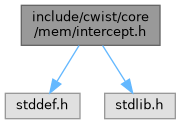
Go to the source code of this file.
Functions | |
| void * | cwist_malloc_shim (size_t size) |
| malloc() replacement: real libc malloc() (uninitialized memory, exactly like malloc - unlike cwist_alloc(), this does not zero), registered with the full-GC pending-sweep list when cwist_full_gc_enabled(); a plain, untracked passthrough otherwise. | |
| void * | cwist_calloc_shim (size_t nmemb, size_t size) |
| calloc() replacement: real libc calloc() (zeroed), registered with the full-GC pending-sweep list when cwist_full_gc_enabled(); a plain, untracked passthrough otherwise. | |
| void * | cwist_realloc_shim (void *ptr, size_t size) |
realloc() replacement. Tracking follows the incoming pointer: if ptr was tracked (shimmed-and-full-GC-was-on at allocation time), the old registration is removed and the new pointer is re-registered (a moved block must not leave a stale entry pointing at freed memory, and should stay reclaimable exactly as the original was). If ptr was untracked (allocated before full-GC was enabled, already disowned, or is NULL), the result is left untracked too - matching cwist_realloc()'s existing behavior of not opting a pointer into tracking on its own. | |
| void | cwist_free_shim (void *ptr) |
free() replacement: untracks ptr first if it was tracked (safe no-op if it wasn't - same contract as cwist_free()), then calls the real libc free(). | |
Detailed Description
Opt-in, translation-unit-scoped malloc/calloc/realloc/free interception onto the full-GC epoch pipeline.
Design rationale (see docs/GC.md section 5 for the full writeup): this is deliberately a header-level macro redefinition, not a link-level -Wl,--wrap=malloc. A link-level wrap intercepts every malloc reference in the final binary, including vendored dependencies (BoringSSL, lsquic, cnats, sqlite3) that never see CWIST's headers and have no reason to expect a non-libc allocator underneath them - concretely, BoringSSL calls OPENSSL_cleanse() on secret key material before freeing it, on the assumption of plain heap semantics; routing that through an epoch-deferred GC arena would be a security regression, not a performance footnote.
A #define malloc cwist_malloc_shim here only ever takes effect in a translation unit that (a) includes this header and (b) defines CWIST_INTERCEPT_MALLOC before doing so. Vendored dependencies do neither, structurally: they are built as separate compilation units that never include a CWIST header. This excludes them by construction, at the cost of not extending coverage beyond code that opts in.
Usage (typically a handler translation unit that wants "write malloc by habit and it still evaporates under cwist_full_gc(true)"):
When cwist_full_gc(true) was never called (the default), every shim function below falls straight through to the real libc call after one relaxed atomic load (cwist_full_gc_enabled(), the same check cwist_alloc()/cwist_free() already pay on every call) - no tracking, no extra bookkeeping. See tests/bench_malloc_intercept.c for the measured overhead of that fallback path, both with the toggle on and off, against a plain uninterecepted malloc/free baseline.
A pointer that legitimately needs to outlive the thread/scope that allocated it (cached in a connection pool, hand it to a background job) calls cwist_gc_scope_disown(ptr) once at the handoff point, exactly as it would for a cwist_alloc() pointer - see include/cwist/core/mem/gc.h and tests/test_full_gc_ownership_handoff.c. No separate escape API is needed for shimmed pointers.
Definition in file intercept.h.
Function Documentation
◆ cwist_calloc_shim()
calloc() replacement: real libc calloc() (zeroed), registered with the full-GC pending-sweep list when cwist_full_gc_enabled(); a plain, untracked passthrough otherwise.
◆ cwist_free_shim()
free() replacement: untracks ptr first if it was tracked (safe no-op if it wasn't - same contract as cwist_free()), then calls the real libc free().
◆ cwist_malloc_shim()
malloc() replacement: real libc malloc() (uninitialized memory, exactly like malloc - unlike cwist_alloc(), this does not zero), registered with the full-GC pending-sweep list when cwist_full_gc_enabled(); a plain, untracked passthrough otherwise.
◆ cwist_realloc_shim()
realloc() replacement. Tracking follows the incoming pointer: if ptr was tracked (shimmed-and-full-GC-was-on at allocation time), the old registration is removed and the new pointer is re-registered (a moved block must not leave a stale entry pointing at freed memory, and should stay reclaimable exactly as the original was). If ptr was untracked (allocated before full-GC was enabled, already disowned, or is NULL), the result is left untracked too - matching cwist_realloc()'s existing behavior of not opting a pointer into tracking on its own.
